

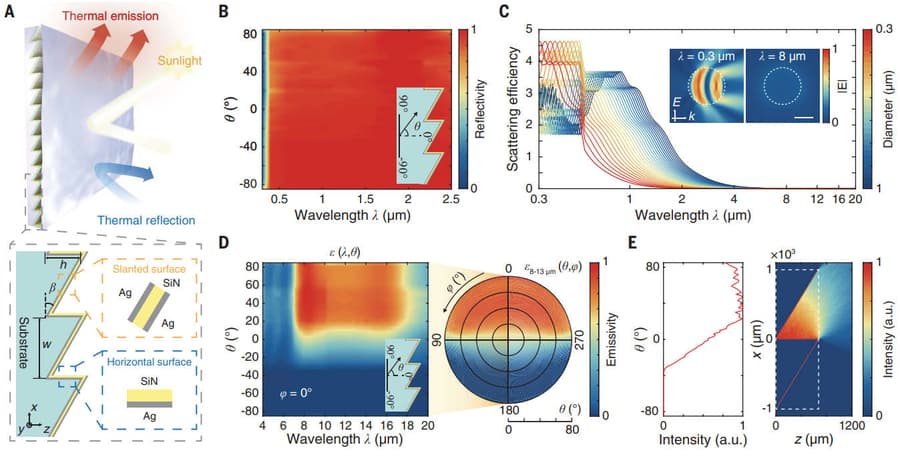
A study published in the journal Science has demonstrated a significant advancement in thermal photonics that enables efficient subambient daytime radiative cooling for vertical surfaces. This breakthrough addresses a longstanding limitation in radiative cooling technology, which has traditionally been confined to horizontal surfaces due to omnidirectional thermal radiation properties. When applied to vertical surfaces, conventional radiative coolers fail to achieve subambient cooling because they absorb heat from the ground, surrounding objects, and atmosphere.
The research team, led by Prof. Wei Li from the Changchun Institute of Optics, Fine Mechanics and Physics of the Chinese Academy of Sciences in collaboration with researchers from Stanford University and the City University of New York, utilized thermal photonics to achieve cross-band synergistic control of thermal radiation in both angle and spectrum. They designed an angularly asymmetric and spectrally selective thermal emitter using a cross-scale symmetry-breaking structure consisting of a sawtooth grating covered by an ultraviolet-visible reflective, IR transparent nanoporous polyethylene film.
This innovative design demonstrated remarkable cooling performance, maintaining a steady-state temperature substantially below ambient temperature throughout the day. Even under peak sunlight conditions, the emitter maintained a temperature 2.5°C below ambient, outperforming conventional high-performance radiative coolers and commercial white paint by 4.3°C and 8.9°C respectively. Prof. Wei Li emphasized the significance of this achievement, noting that the design strategy's flexible ability to tune the angular coverage of thermal emission allows for redesign based on practical scenarios, enabling subambient radiative cooling even when facing hot building walls.
The implications of this breakthrough are substantial for energy efficiency applications. The technology could be applied to various real-world scenarios involving inclined or vertical surfaces, including building walls, clothing, and vehicle sides. This advancement has potential to significantly reduce heating costs and global energy consumption while offering new thermal management solutions for energy-efficient technologies. The study represents a dimensional leap in radiative cooling technology, expanding its applicability from horizontal surfaces to practical three-dimensional scenarios and opening new possibilities in energy and sustainability fields.
As climate change and energy efficiency challenges persist, innovations like this angularly asymmetric and spectrally selective thermal emitter technology offer promising solutions by enabling more efficient cooling methods that require less energy input. This could contribute to reducing overall energy consumption and greenhouse gas emissions associated with traditional cooling systems. The research was supported by grants from the National Natural Science Foundation of China, the US Department of Energy, and a Vannevar Bush Faculty Fellowship, highlighting the international collaboration behind this advancement. As researchers continue to refine this technology, it may pave the way for energy-efficient buildings, vehicles, and clothing that maintain comfortable temperatures with minimal energy input, advancing both thermal photonics and sustainable energy solutions.