

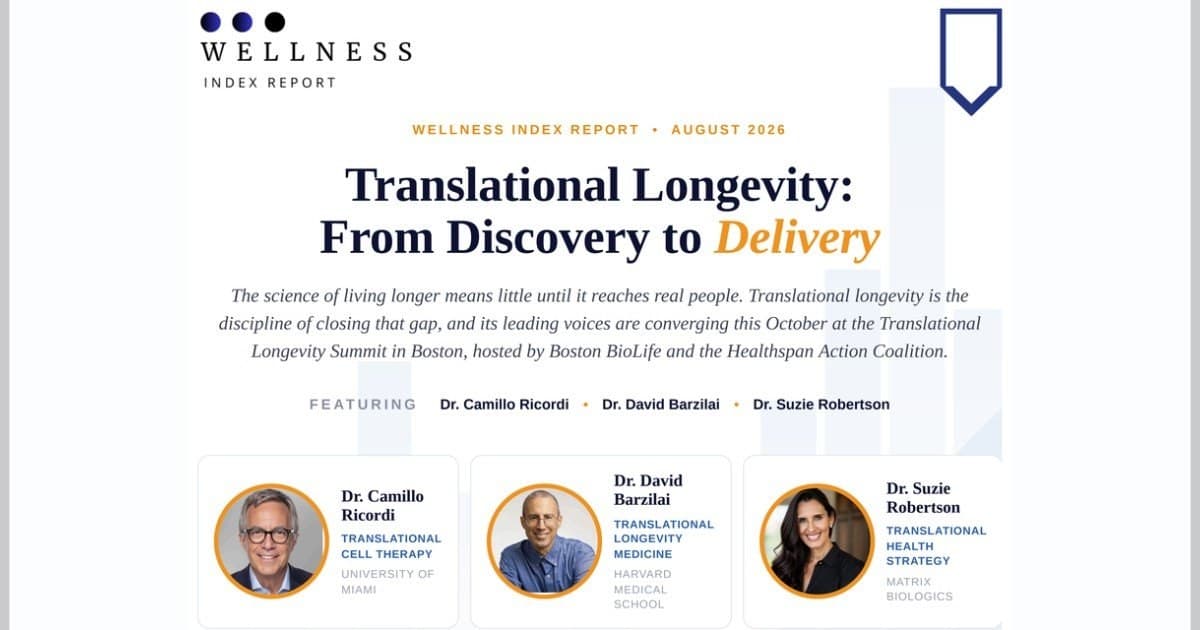
The August Wellness Index Report, published by Wellness Eternal, focuses on translational longevity—the discipline that determines whether longevity science reaches anyone at all. According to the report, the science of living longer means little until it reaches real people. Translational longevity is the work of closing that gap, and its leading voices will converge this October at the Translational Longevity Summit in Boston, hosted by Boston BioLife and the Healthspan Action Coalition.
The report identifies three defining signals for the field: cell science shifting from proof of concept to real clinical delivery, evidence emerging as the bridge from research to practice, and clinical strategy and systems proving essential to scaling care safely and consistently. These signals underscore a growing recognition that the longevity industry must move beyond laboratory discoveries to practical, patient-centered applications.
The Translational Longevity Summit runs October 7 to 11 at the Harvard Enterprise Research Campus in Boston, hosted by Joseph Krieger of Boston BioLife and Bernard Siegel of the Healthspan Action Coalition. The event is expected to bring together researchers, clinicians, and industry leaders to address the challenges of translating longevity science into clinical practice. For those interested in attending or learning more, the full announcement, including downloadable images and bios, is available here.
This news matters because it highlights a critical inflection point in the longevity field. While much attention has been paid to breakthroughs in aging research, the report argues that real progress is won in the translation of those breakthroughs to the bedside. For readers, this means that the next wave of longevity innovations will likely focus on delivery mechanisms, clinical validation, and scalable care models rather than purely scientific discovery. The emphasis on evidence as a bridge from research to practice suggests that consumers and patients can expect more rigorous standards for longevity interventions, potentially leading to safer and more effective options.
For the industry, the report signals a shift toward clinical strategy and systems. Companies that can demonstrate real-world delivery and consistent outcomes may gain a competitive edge. The summit in Boston will likely serve as a catalyst for collaborations and announcements that could shape the trajectory of the longevity sector. As the field matures, stakeholders across health and wellness should watch for developments in translational longevity, as they may influence everything from regulatory pathways to reimbursement models.
The Wellness Index Report is an independent, practitioner-led research platform published monthly by Wellness Eternal. It evaluates wellness providers, technologies, and protocols through a four-step process: expert nomination, customer and patient feedback, clinical review, and ongoing rating analysis. The report is distributed across major media outlets and reaches a global audience, providing visibility to solutions that meet its integrity-first standard. Practitioners, companies, and innovators interested in being considered for future reports can participate by completing the official submission and review process. The full August report is available at wellnessindexreport.com.
