

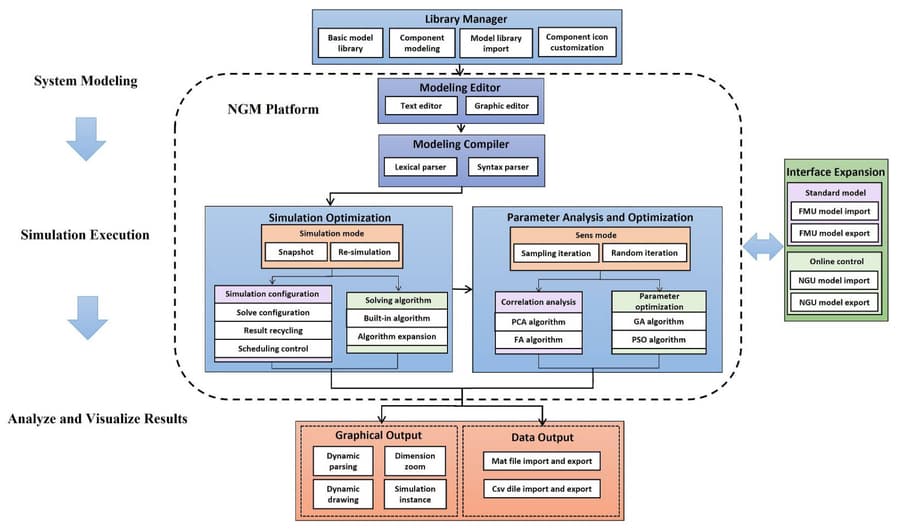
The introduction of a novel digital twin platform by Zhejiang University researchers represents a significant advancement in industrial technology with far-reaching implications for process optimization and innovation. Published in the journal Digital Twins and Applications, the Novel Generation Modelling system creates highly accurate virtual replicas of physical systems, allowing companies to optimize operations, enhance productivity, and fuel innovation in ways previously unattainable. This development comes at a critical time as industries worldwide seek to harness data-driven automation and connectivity through Industry 4.0 initiatives, yet existing platforms have struggled with integrating complex data streams from multiple sources.
The NGM system addresses these integration challenges through a highly scalable and accurate modeling environment built on the open-source programming language Modelica. The platform features eight integrated modules including editors, simulators, and compilers that effortlessly model chemical, electrical, thermal, and fluid systems. According to Professor Wenhai Wang, the project's lead researcher, "Our NGM platform addresses longstanding integration challenges in DT technology. By offering a highly scalable and accurate modeling environment, we empower industries to achieve unprecedented levels of efficiency and reliability." This breakthrough enables not only simulation but also optimization of industrial systems for peak performance, paving the way for safer and more optimized industrial control systems.
The implications of this technology extend across multiple industries, from chemical plants to energy production facilities, where it promises substantial benefits through predictive maintenance and continuous real-time monitoring. By minimizing downtime, lowering operational costs, and reducing environmental impact, the NGM platform could set new standards for smart manufacturing while making factories safer, greener, and significantly more efficient. The development received support from several funding sources including the Industrial Internet Development Project of the Ministry of Industry and Information Technology, the National Key Research and Development Program of China, and the National Natural Science Foundation of China, underscoring the project's importance and potential global impact on industrial practices.
As industries continue their digital transformation, the NGM platform represents a crucial step toward realizing the full potential of Industry 4.0 by providing comprehensive solutions for creating and managing digital twins. This technology has the potential to revolutionize how companies approach process optimization, risk management, and innovation through accurate virtual replicas of complex systems. Beyond immediate industrial applications, the advancement could lead to breakthroughs in fields such as urban planning, healthcare, and environmental management by enabling scenario testing, outcome prediction, and informed decision-making across diverse contexts. With implementation of this technology, significant improvements in efficiency, safety, and sustainability across various sectors are anticipated, potentially ending inefficient and error-prone industrial processes through next-generation digital twin capabilities.