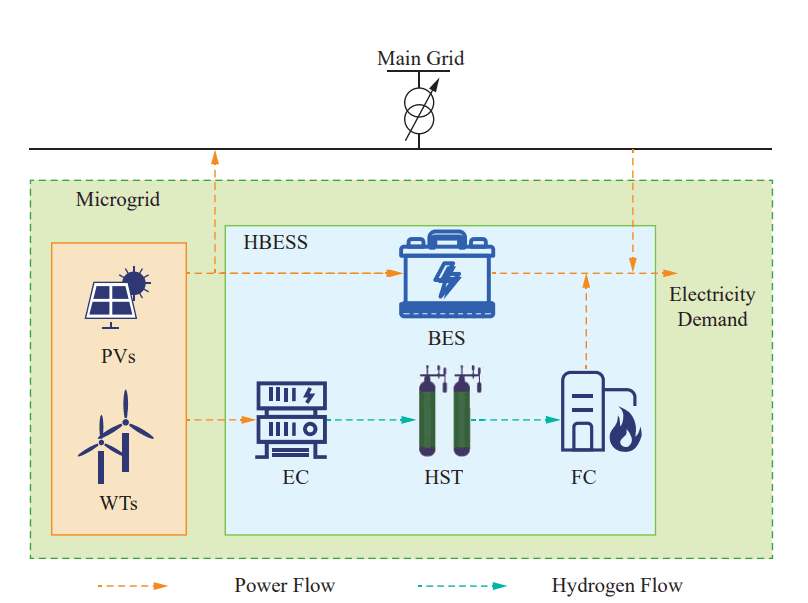
Researchers have developed a new adaptive robust optimization approach for hybrid hydrogen-battery energy storage systems operating within microgrids, aiming to minimize operating costs while effectively managing the state-of-charge of battery storage systems. The study, led by Professor Xu Zhao from The Hong Kong Polytechnic University, introduces a two-stage model that addresses the challenges of integrating hydrogen and battery storage in microgrids. The day-ahead stage employs robust optimization to establish hydrogen dispatch and battery storage state-of-charge boundaries, while the intraday stage focuses on dispatching battery storage within these defined intervals, considering uncertainty realization from a comprehensive daily perspective.
This innovative approach is designed to hedge against uncertainties in renewable energy generation and demand, a critical issue in microgrid management. The adaptive robust optimization method integrates the hybrid hydrogen-battery energy storage system operation model with integer recourse variables, solved using a novel outer-inner-CCG algorithm. Simulation results have demonstrated the exceptional performance, efficiency, and resilience of this adaptive robust operation model. The implications of this research are far-reaching for the renewable energy sector as the world increasingly shifts toward sustainable energy solutions, where efficient management of energy storage systems becomes paramount.
This model could significantly reduce operating costs for microgrids, making renewable energy more economically viable and encouraging wider adoption. Furthermore, the study's focus on hybrid systems combining hydrogen and battery storage showcases the potential for diverse energy storage solutions to work in tandem. This approach could lead to more flexible and resilient energy systems capable of adapting to varying energy production and demand patterns. The research team's work is particularly timely given the global push for decarbonization and the increasing integration of renewable energy sources into existing power grids.
By optimizing the operation of hybrid hydrogen-battery energy storage systems within microgrids, this model could play a crucial role in facilitating the transition to a more sustainable energy future. The study was supported by grants from the National Natural Science Foundation of China and a PolyU research project, highlighting the collaborative nature of cutting-edge energy research. The findings have been published in the journal Global Energy Interconnection, which focuses on large-scale low carbon energy technologies, global energy interconnection, and climate change impacts.
As the energy sector continues to evolve, research like this paves the way for more efficient, cost-effective, and environmentally friendly power systems. The adaptive robust optimization model for hybrid hydrogen-battery energy storage systems in microgrids represents a significant step forward in addressing the complexities of renewable energy integration and storage management. This development marks another milestone in the ongoing journey toward a sustainable and interconnected global energy system.